Mexican Spanish vs Spain Spanish: What Your Audience Hears
Mexico has about 130 million native Spanish speakers and Spain about 47 million, according to the Instituto Cervantes 2025 yearbook. Play the same line in a voice from each, and a native listener will usually hear which is which before the sentence is over, often at a word as ordinary as gracias.
TL;DR: Mexican Spanish vs Spain Spanish is one language with two sets of habits: a few sounds, vosotros versus ustedes, and everyday words. Speakers understand each other easily. Choose by where your listeners live.
The written language barely changes
A news story written in Madrid reads fine in Mexico City. The Real Academia Española and the Spanish-language academies of the Americas publish a shared dictionary and a shared grammar, and educated speakers on both sides of the Atlantic follow each other without effort. Fast, slangy conversation can take a moment to tune into in either direction, as it can between two regions of the same country.
What differs is mostly sound, plus a handful of grammar habits and everyday words. Those are small, and audiences hear them anyway. Many films and series are dubbed into Spanish twice, once for Spain and once for Latin America, because each audience tends to hear the other's version as foreign.
So a Mexican speaker is understood perfectly well in Spain. They will be heard as Mexican within a few words, and now and then a word will land differently than intended (more on coger below).
Two naming notes save confusion. In English, "Castilian Spanish" usually means the Spanish of Spain; in Spain, castellano is simply the name of the language, and many Latin Americans use the word too. "Latin American Spanish", meanwhile, covers many accents, and Mexican Spanish is one of them.
A disclosure before the details: we make SpanishTTS, which sells voices from Spain and from Latin America alike, so neither answer earns us more. We would just rather you chose on purpose.
Pronunciation: the z, the j and the final s
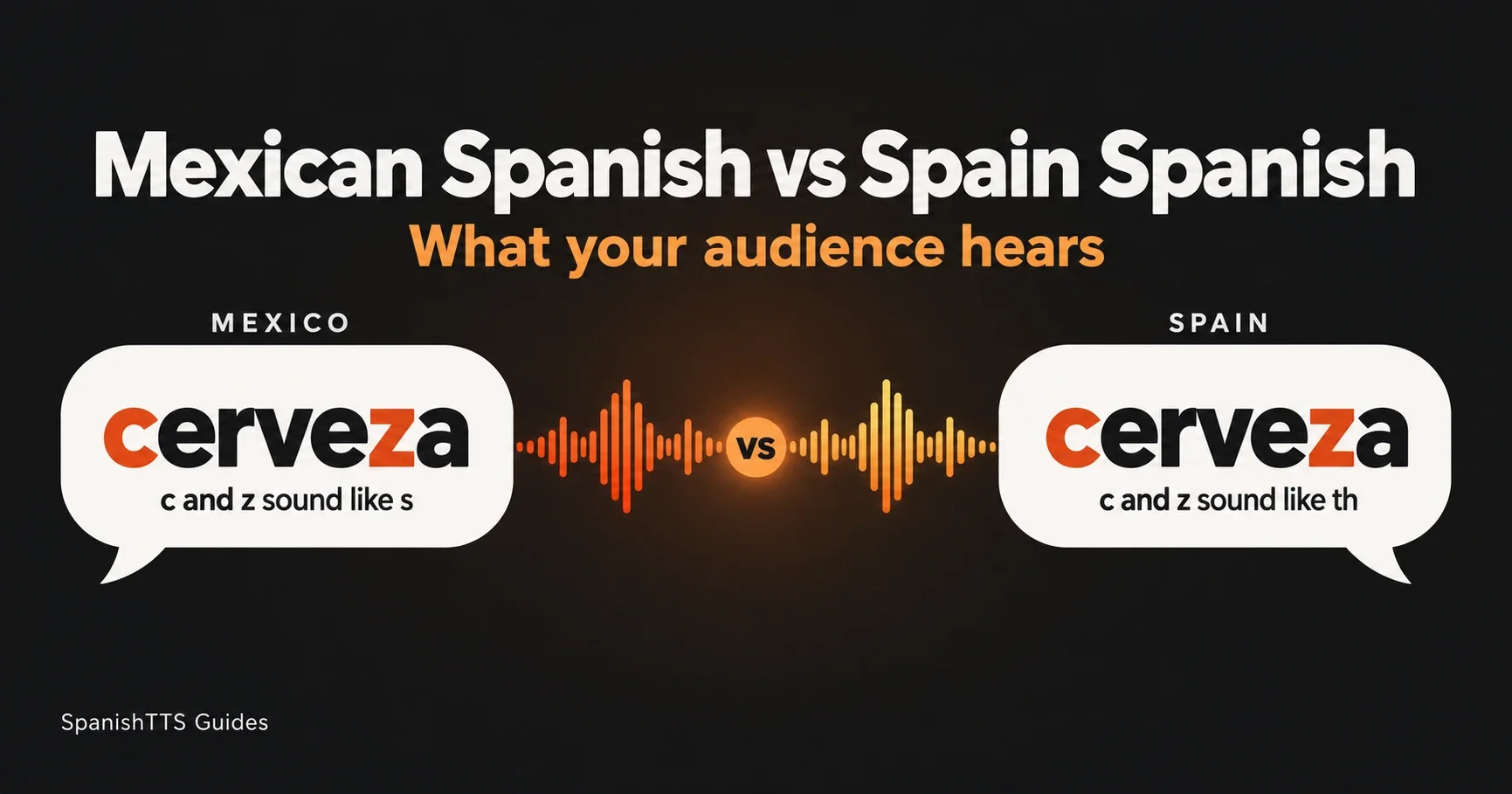
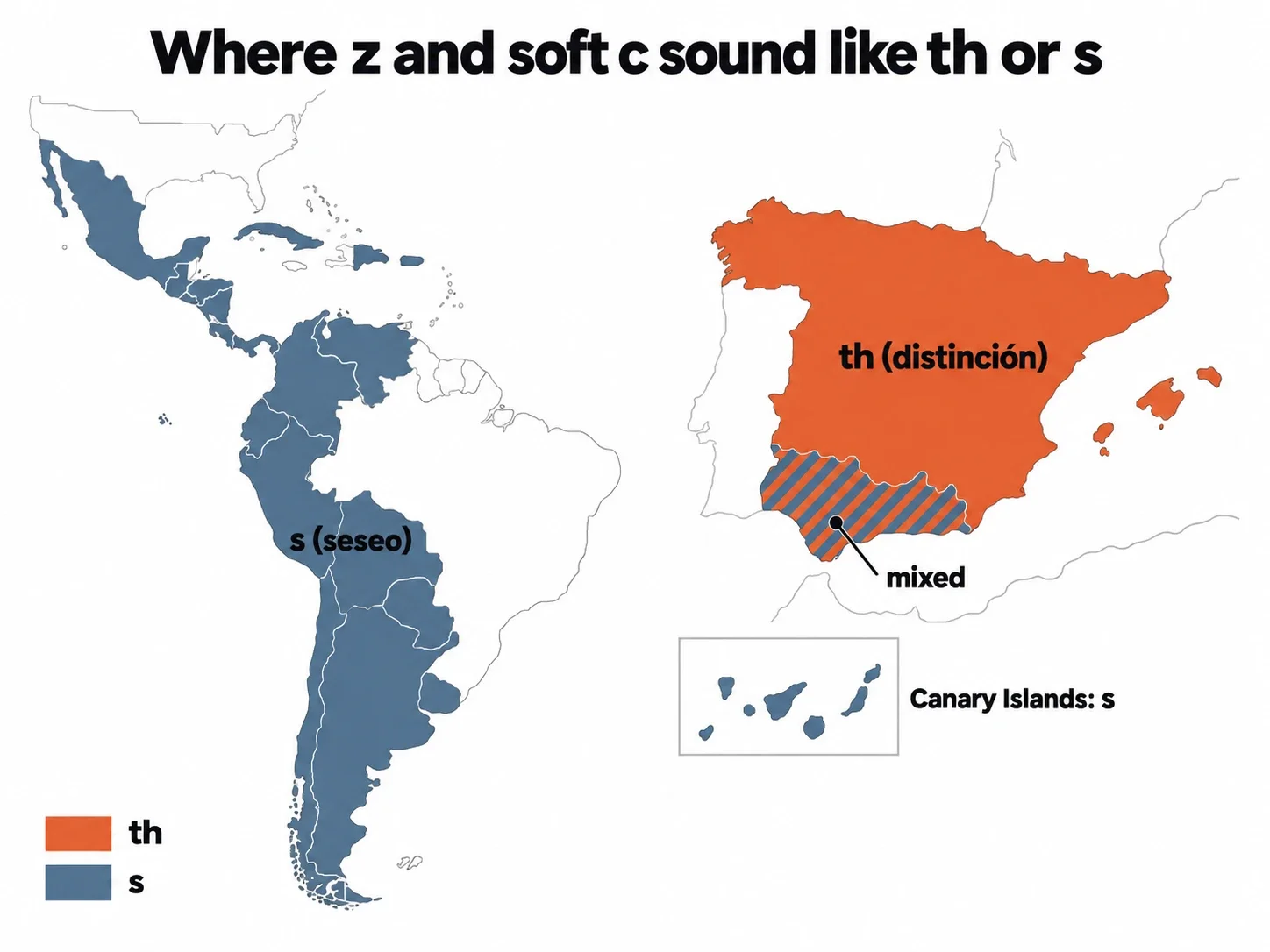
In central and northern Spain, z and a c before e or i are pronounced like the th in "think". Cinco begins with that sound, and cerveza has it twice. Linguists call this distinción, since Spain keeps the sound apart from s.
Mexico, the rest of Latin America, the Canary Islands and parts of Andalusia use seseo instead and pronounce those letters as s. That makes casa (house) and caza (hunt) identical in Mexico City and different in Madrid. English speakers often call the Spain version a lisp, but a speaker from Madrid still says s wherever the spelling has an s; only z, ce and ci change.
Two more sounds do much of the remaining work:
- The j, along with g before e or i. Spain tends to pronounce it harder, further back in the throat. In Mexico it is softer.
- An s at the end of a syllable. Central Mexico keeps it clear, so ¿cómo estás? ends on a full s, where much of southern Spain and the Caribbean soften or drop it. In quick Mexican speech it is the unstressed vowels around that s that shrink instead.
Some sounds don't separate the two at all. In most of both countries ll and y are pronounced alike, so pollo (chicken) and poyo (stone bench) sound the same in Madrid and in Mexico City.
None of these differences show up in writing. Cerveza is spelled the same everywhere, so the pronunciation comes from the voice you choose. If you want to hear peninsular speech on short scripts without making an account, the three sample voices on our demo are all from Spain.
Vosotros, and two habits a script can't hide
Spain uses vosotros for an informal "you all", with verb forms of its own: vosotros tenéis, os va a encantar. Mexico and the rest of Latin America use ustedes for every group, friends included: ustedes tienen, les va a encantar. The sample line in our own editor ends with os va a encantar, and that one pronoun is enough to place it in Spain.
It matters most in ads and calls to action, where "you all" is exactly who is being spoken to. Text to speech reads the words it is given, so a Mexican voice reading descargad la app (Spain's informal plural command) sounds like a Mexican actor handed lines written for Madrid.
The second habit is the tense for things that happened today. Spain reaches for the present perfect, hoy he ido al banco; Mexico uses the simple past, hoy fui al banco. Both are correct and understood everywhere, though each sounds faintly foreign to the other side.
The third, leísmo, is narrower. In central Spain, Madrid included, many speakers say le vi for "I saw him", where a Mexican speaker says lo vi.
Swap these words before you record
Vocabulary is where a translated script most often gives itself away. These pairs turn up again and again in voiceover and product copy:
| English | Spain | Mexico |
|---|---|---|
| car | coche | carro |
| computer | ordenador | computadora |
| mobile phone | móvil | celular |
| juice | zumo | jugo |
| apartment | piso | departamento |
| bus | autobús | camión |
| potato | patata | papa |
| glasses | gafas | lentes |
| to drive | conducir | manejar |
| tomato | tomate | jitomate |
One word needs its own warning. In Spain, coger means to take or to catch, and coger el autobús is as plain as a sentence gets. In Mexico and Argentina, coger is vulgar slang for sex. When a script could be heard on both sides of the Atlantic, tomar is the safe verb.
Slang travels worst of all. "Cool" is guay in Spain and padre or chido in Mexico, and each sounds borrowed outside its home. Several everyday Mexican words also come from Nahuatl, the language of the Aztecs: jitomate is one, and guajolote (turkey) and papalote (kite) are others that a listener in Spain may not know at all.
One ad read, written twice
Here is a two-line app promo localized both ways. The English source:
Still don't have the app on your phone? Download it today: your first ride is free.
| Spain | Mexico |
|---|---|
| ¿Todavía no tenéis la app en el móvil? Descargadla hoy: vuestro primer viaje es gratis. | ¿Todavía no tienen la app en el celular? Descárguenla hoy: su primer viaje es gratis. |
Four things changed between the columns: the verb (tenéis and tienen), the command (descargadla and descárguenla), the possessive (vuestro and su) and one noun (móvil and celular). Nothing on the page tells a voice how to pronounce either version, which is why the accent of the voice has to be chosen separately.
Latin America has more than one accent
Framed as Latin American Spanish vs Spain Spanish, the question sounds like a choice between two options, yet the Latin American side holds many accents. Argentina and Uruguay use vos in place of tú, with its own verb forms, such as vos tenés, and pronounce ll and y close to the sh in "shop". Much of the Caribbean, Colombia and Venezuela soften the j until it is close to an English h.
| Spain | Mexico | Argentina | |
|---|---|---|---|
| z and soft c | like th | like s | like s |
| ll and y | like y | like y | like sh |
| "you", one friend | tú | tú | vos |
| "you all", informal | vosotros | ustedes | ustedes |
| car | coche | carro | auto |
For audiences spread across several countries, the long-standing industry answer is neutral Spanish, español neutro. Hollywood dubbing for Latin America has relied on it since the 1950s, with Mexico as its main dubbing hub, and it steers around vosotros, vos and strongly local slang. The trade is some naturalness for reach. Whether that suits your content depends on how local it needs to feel, and we don't think there is one right answer.
Which one your audience expects
Where your listeners live settles more of this than any ranking of accents could.
- Spanish speakers in the United States. The U.S. Hispanic population reached 68 million in 2024, and 57% of it is of Mexican origin, according to the Pew Research Center. For most of that audience a Mexican or broadly Latin American voice sounds familiar, and a voice from Spain sounds imported.
- An audience in Spain. A Spain voice, Spain vocabulary, and vosotros wherever the tone is informal.
- Several Latin American countries at once. A broadly Latin American voice with neutral vocabulary: no vosotros, no vos, no coger.
- One country in particular. That country's accent, if a voice with it exists.
- Learners. Whichever variety you will hear most, from a teacher, a partner or a place you are moving to. Both are understood everywhere, and on our Precise engine a voice can be slowed down for practice.
- No clear market yet. If you already have viewers, look at where they are; YouTube Studio and most analytics tools break an audience down by country. Without that data, follow the numbers: Mexico alone has close to three times as many native Spanish speakers as Spain.
Then check the script against that choice before anything is voiced. For a Latin American audience, search it for vosotros forms (the pronoun os, and verb endings such as -áis and -éis), for coger, and for anything in the Spain column above. For Spain, run the same check the other way round. Budget for length too: in our own measurements, a script translated from English comes out roughly 15–25% longer in Spanish, which matters when the audio has to fit a video that is already cut.
This is also the point where the voice gets picked. SpanishTTS sorts its Spanish voices by accent. At the time of writing that means 618 broadly Latin American voices, 327 from Spain and 191 Mexican, along with Colombian, Argentine, Peruvian, Chilean and Venezuelan ones, so you can match the voice to the script. Commercial use comes with every paid plan, starting at Starter.
The accent labels have a limit worth knowing. They name a country or a region, not a city, so they won't tell you whether a voice sounds like Seville or Monterrey; if your audience is that local, listen to a line before you commit. The engine also reads exactly what you write, so a script that says carro gets carro from every accent.
Most of the Mexican vs Spain decision is made before anyone presses play, in the pronoun for "you all" and the word for car. Once the script matches your listeners, pick a voice in the same accent and listen to one line before you generate the rest.